
- What makes a good domain name
- How to properly register and protect your domain name(s)
- The pros/cons of changing an existing domain name
Even if your operates on a single domain name without the problem of multiple websites, your primary domain name might not be the best that it can be.
What makes a good domain name?
- As short as possible: Given that most short domains are taken this is still a good rule to follow. People are getting used to slightly longer domain names but there’s a limit.
- Not too many extraneous characters: It’s true that having dashes in the domain name will not hurt your SEO rankings. But it does make it harder to remember, it looks spammy, it’s easier to mis-type. And if you’re getting samantha-smith-cakes.com.au it probably means the one without dashes is already taken. Which leaves you open, even if the domain without dashes isn’t a live website now, it could be, which would introduce a lot of confusion.
- Easy to pronounce: Most of the time your domain name will contain more than one actual word, in which case make sure that word boundaries are clear.
- samanthasmithcakes.com.au is ok but the first word could be read as “Samantha’s”
- trenttailortiling.com.au is a bit hard to parse
- designbystuart.com.au is very clear with almost no chance of confusion.
- Good choice of domain extension: There are lots more top-level domain names on the market like .sydney, .app etc and people are getting more familiar with them. But a .com.au is still the extension that makes the most sense for an Australian business if you can get it. In early 2022, the .au domain is also scheduled to release, but first dibs on those will go to the existing .com.au owners. Watch out for extensions often used by spammers since it might make customers pre-judge you in a negative light (eg. .biz, .info etc). And yes, getting the domain name for your specific country (eg. .org.au over .org) is worth it.
- Not too generic: If your business and domain name is just your location and service (eg. balmainbakery.com.au), this may make it slightly easier to rank especially on a local search such as Google Maps. This wouldn’t be the case for a very broad location such as an entire city but for a suburb it may give you a slight edge. However this comes at the expense of branding. If your business is called just “Balmain Bakery” then people searching for those keywords may not have you in mind. If the space of bakeries in Balmain gets very cutthroat you may find it hard to rank for your own name/brand. This is something you have to weigh up but it may be possible to get the best of both worlds with a hybrid name (eg. “Sam’s Bakery Balmain”), although you should also make sure that it sounds good.
- Not too specific: As per the previous chapter, if you peg your domain to a very specific service it might make it harder to expand.
- Not easily confused/infringing: Don’t get a lawyer’s letter from a brand who believes you’ve infringed on their trademark or are trying to pass off as them etc.
How to register a domain name (properly)
Based on the above list you might think that finding a good domain is very hard – and it can be! There are some websites that help you in the brainstorming process, for example Instant Domain Search.
It’s good to register your domain name at a domain name registrar. Sometimes your hosting company or website builder will include the domain registration as part of the package. But then if you decide to move, will you actually keep your domain name? If you own a domain using this method you may want to find out. You can use auDA’s Whois lookup tool to check who has actually got control over your domain name.

Domain names are a commodity, as long as your registrar has successfully registered the domain name on your behalf the job is done. This means there is not much room for good quality of service here, so you should feel free to shop around for a cheap registrar, as long as they are reputable. There are plenty of domain price comparison websites like this one to get you started. Conversely, beware – we’ve seen some Australian companies charging in excess of $100 for a domain name registration, when you can get one for around $10.

My domain name isn’t ideal, should I change it?
This is a tough decision since changing it is often a pain. You also need to make sure this is done properly otherwise you may lose a lot (or all) your traffic. The project will definitely need some help from someone who understands web development, SEO and digital analytics but the major elements for you to be aware of are:
- All the old domain’s links should be set up to redirect to your new domain name, ideally using a 301 redirect (more info on 301s here).
- You should file a change of address notice with Google Search Console.
- It’s best to hold on to registration of your old domain name indefinitely, or at least until you’re confident that both users and search engines have updated all their links and nobody will see an old link again.
Even with a great domain migration, you will probably still see a dropoff in traffic. However, search engines are now much better at dealing with website changes, especially if the only change is your domain name. Meaning that traffic will generally recover quite quickly. If the domain name is a better fit you may end up seeing benefits within a few months.
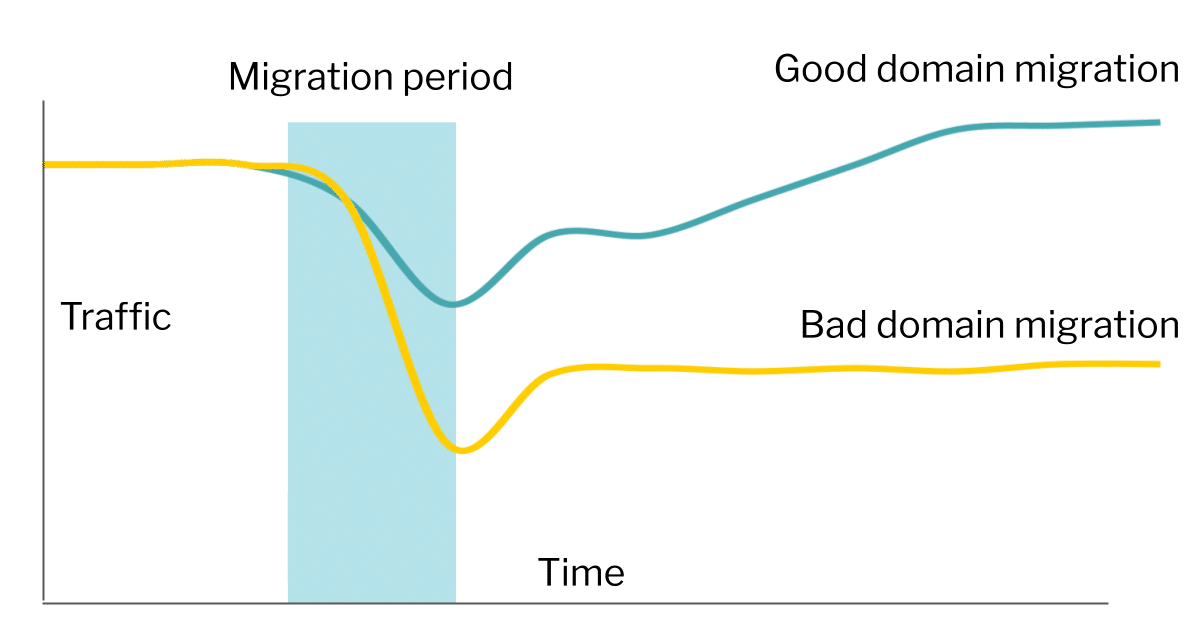
Annoyingly, even though there may be temporary downsides to moving domains, long-term if you are going to do it, the sooner the better, as years down the line you may have more traffic to lose. So the best time to move domains is never but the second best is (if you need to) as soon as possible.

